November 6, 2026 · 3523 words
SEO Content Automation: The Complete Architectural Blueprint for Autonomous Organic Publishing
Discover the architectural blueprint for SEO content automation. Learn how autonomous pipelines handle entity extraction, intent modeling, and CMS delivery.
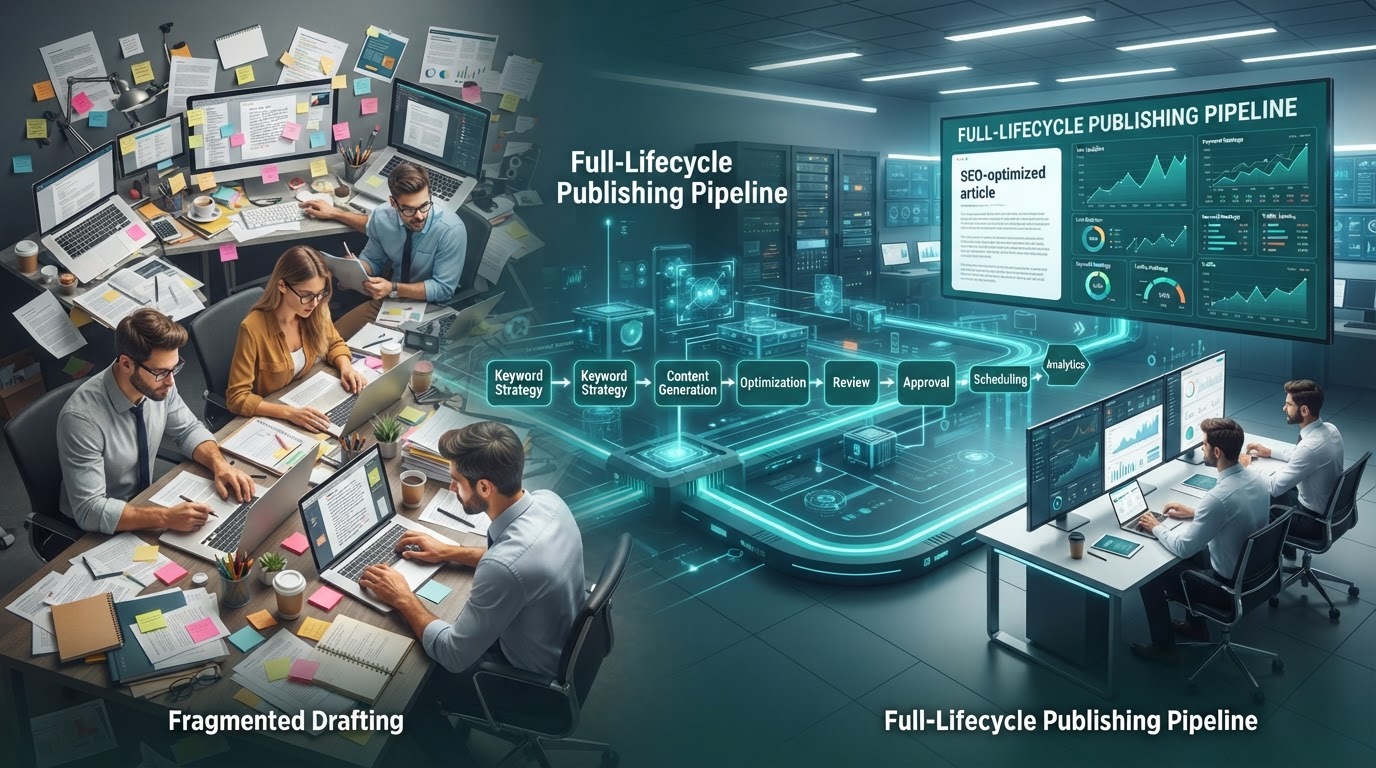
SEO content automation is the programmatic orchestration of data ingestion, search intent modeling, text generation, internal linking, and content management system (CMS) deployment to execute organic publishing without manual operational friction. Rather than treating content production as an isolated drafting exercise, enterprise automation couples real-time search engine results page (SERP) diagnostics with natural language models, knowledge graph alignment, and structured data injection. This unified process moves digital publishing from reactive, single-article authoring to a continuous, scalable, and technically compliant acquisition engine.
Autonomous publishing infrastructure replaces the human bottlenecks of legacy editorial teams with systematic machine intelligence.
- Pipeline integration beats text generation. True automation coordinates technical site audits, competitive crawling, entity modeling, and headless publishing rather than stopping at raw prose creation.
- Algorithmic compliance demands information gain. Scaled systems must introduce verifiable data, authoritative citations, and structural entity depth to clear modern spam thresholds and secure sustained rankings.
- Unified agents replace fragmented stacks. Autonomous platforms consolidate keyword clustering, schema validation, and bidirectional link graph distribution into a single continuous operational loop.
Key Takeaways
| Point | Details |
|---|---|
| Architecture | Modern systems operate across five technical layers: diagnostic scanning, entity extraction, intent modeling, generation, and headless CMS execution. |
| Search Compliance | Adherence to Google Web Search spam policies requires algorithmic guardrails against scaled content abuse and a programmatic commitment to information gain. |
| Entity Disambiguation | Advanced systems use automated JSON-LD markup mapped to Schema.org types to feed search crawlers and retrieval-augmented generation (RAG) vector stores simultaneously. |
| Economic Model | Automation reduces the traditional manual production cost of $150 to $600 per article by up to 80% while compressing publishing cycles from weeks to minutes. |
| CitedGiraffe Advantage | CitedGiraffe executes this entire lifecycle by scanning your domain architecture for free to plan, generate, and publish fully optimized assets directly to your CMS on autopilot. |
Table of Contents
- Key Takeaways
- SEO Content Automation Replaces Fragmented Drafting with Full-Lifecycle Publishing Pipelines
- Modern Content Automation Operates Across Five Distinct Technical Layers
- Programmatic Entity Validation Secures Authority Across Traditional SERPs and Generative Engines
- Autonomous Link Graph Routing Prevents Content Cannibalization and Diluted PageRank
- High-Performance Systems Engineer Information Gain to Satisfy Modern Quality Standards
- Google Search Essentials Mandates Strict Operational Guardrails for Scaled Publishing
- Automating the Editorial Pipeline Radically Restructures Production Economics and Velocity
- Autonomous Publishing Pipelines Must Optimize Simultaneously for RAG Systems and Web Crawlers
- Selecting an Enterprise Automation Platform Requires a Diagnostic-First Technical Audit
- Deploying an Autopilot Content Strategy Demands Structured Milestone Validation
- Our Stance on SEO Content Automation
- Automate Your Organic Search Pipeline with CitedGiraffe
- Next Steps
- FAQ
- Sources
- Recommended Reads
SEO Content Automation Replaces Fragmented Drafting with Full-Lifecycle Publishing Pipelines
Traditional search engine optimization relies on fractured, linear steps: keyword discovery, manual drafting, editorial reviews, manual internal linking, and CMS uploads. This manual sequence creates operational debt. Publishing a single technical article often demands between 6 and 14 days of turnaround time. Meanwhile, SERP competitors capture topical velocity. True automation dissolves these administrative friction points by binding computational linguistic models directly to real-time search engine indexing standards.
What it is not: SEO content automation is not a single prompt pasted into a consumer chatbot to spit out unverified text. It is not an unmonitored mass-page spam generator that floods indexes with duplicate content. It is an engineering discipline that couples data pipelines with large language models, structured markup, and programmatic internal link graphs.
Prompt Wrappers Versus Autonomous Agentic Engines
Simple prompt wrappers rely on static user prompts to generate text blocks. They lack technical context regarding your domain's existing URL taxonomy, crawl budget, backlink profile, or entity gaps. An autonomous agentic engine operates with multi-step reasoning capabilities defined under artificial intelligence concepts like those in ISO/IEC 22989:2022. An agentic platform queries live search data, audits existing page authority, forms topical clusters, plans technical architectures, drafts copy according to strict brand parameters, and issues API payloads to your web server.
Pro tip. Treat content engines as autonomous software agents, not copy paste writing aids. Insist on systems that maintain state across your entire site topology rather than generating one-off markdown files.
The Shift from Manual Production to Continuous Indexation
Manual organic publishing is inherently bursty. Teams publish 4 to 8 articles per month, measure performance after 90 days, and adjust. This slow cadence starves search engine spiders of regular crawl signals. In contrast, an automated content engine maintains a continuous publishing velocity. By deploying 20 to 50 deeply researched, structurally sound assets every month, your domain establishes semantic authority across programmatic clusters in a fraction of the time. This steady publishing cadence signals topical depth to search algorithms while capturing long-tail query variations that competitors ignore.
Modern Content Automation Operates Across Five Distinct Technical Layers
To produce assets that outrank established industry competitors, an enterprise platform must execute across five modular, interconnected layers. Bypassing any single layer degrades the mechanical integrity of the final URL.
| Operational Layer | Core Technical Function | Primary System Output |
|---|---|---|
| 1. Diagnostic Scanning | Crawl tree analysis, authority scoring, content gap calculation | Prioritized topic roadmap mapped to technical vulnerabilities |
| 2. Entity Alignment | Wikidata, Google Knowledge Graph, and schema extraction | Disambiguated semantic entity map across target clusters |
| 3. SERP Modeling | Information gain analysis, search intent clustering, heading topology | Algorithmic article blueprint and required structural nodes |
| 4. Generation Engine | Context-conditioned drafting, data point synthesis, brand styling | Original, fully referenced, high-information text assets |
| 5. CMS Integration | Headless publishing, JSON-LD injection, bidirectional linking | Live, crawlable URLs with verified canonical directives |
Diagnostic Site Scanning and Authority Mapping
Automation cannot begin with an empty input box. The system must crawl your domain to log every published canonical URL, its existing primary keyword focus, internal link equity, and entity associations. Diagnostic site scanning maps your current topical authority, identifying where your content inventory has thin coverage, duplicate intent, or underperforming ranking positions. Establishing this baseline guarantees the system generates new assets that strengthen existing clusters rather than cannibalizing legacy URLs.
Entity Extraction and Knowledge Graph Alignment
Search engines process text through semantic entity relationships rather than simple keyword frequencies. An automated engine extracts named entities from top-ranking URLs, cross-references them with structured knowledge bases, and integrates them naturally into the generation pipeline. This step ensures algorithmic parsers recognize the precise relationship between your brand, core offerings, and target topical themes.
Dynamic SERP Modeling and Intent Classification
Search intent shifts continuously. Modern automation tools query Google SERP endpoints in real time to classify whether a query demands an informational blueprint, a commercial comparison table, or a procedural how-to guide. By dissecting the heading hierarchies, media formats, and structural layouts of the top 10 results, the system constructs a dynamic outline designed to address search queries comprehensively.
Algorithmic Text Generation and Information Gain Injection
Large language models tend to regurgitate training data averages unless constrained by strict architectural parameters. Advanced content systems solve this by injecting proprietary perspectives, empirical statistics, and distinct counter-arguments into the generation prompt layer. By deliberately introducing unique data points that do not appear in competing SERP results, the system satisfies modern information gain scoring algorithms.
Automated CMS Integration and Schema Deployment
Copying and pasting text into WordPress, Webflow, or custom Shopify stores introduces human error and technical bottlenecks. Modern platforms use authenticated REST or GraphQL APIs to stage or publish finalized HTML directly into your CMS. Alongside the body text, the system injects optimized title tags, meta descriptions, alt attributes, and JSON-LD schema blocks without requiring manual developer intervention.
Programmatic Entity Validation Secures Authority Across Traditional SERPs and Generative Engines
Traditional search engines and generative AI answers parse web pages through mathematical entity graphs. When your pages contain ambiguity regarding people, concepts, products, or specifications, search engine algorithms reduce your topical authority scores. Enterprise automation systems programmatically validate every named entity before code deployment.
JSON-LD Schema Automation Beyond Basic Article Markup
Most CMS platforms deploy generic BlogPosting or Schema.org Article templates that omit entity references. High-performance automation engines inject nested JSON-LD structures that declare precise entity identities using about and mentions properties. These schemas connect concepts directly to verified external data sources like Wikidata URIs, helping search engines categorize content with algorithmic precision.
Pro tip. Never rely solely on auto-generated CMS schemas. Validate that your automated pipeline inserts explicit sameAs links inside your JSON-LD blocks to tie your proprietary terms directly to recognized industry knowledge graphs.
Disambiguating Topical Entities for Algorithmic Parsers
Polysemy—where a single term holds multiple meanings—creates indexation errors. If your software manages logistical systems, algorithms must distinguish your platform from generic transport brokers or consumer package apps. Automated content pipelines analyze surrounding co-occurrence matrices, systematically embedding contextual anchor terms to eliminate topical ambiguity across indexing nodes.
Autonomous Link Graph Routing Prevents Content Cannibalization and Diluted PageRank
As websites scale past 500 URLs, manual internal link management collapses. Content editors miss opportunities to pass internal PageRank from authoritative legacy articles to newly published pieces. Worse, they inadvertently use identical anchor text to point to competing URLs, causing keyword cannibalization.
Bidirectional Contextual Linking at Scale
Autonomous pipelines resolve this through programmatic link routing. When publishing a new article, the engine does not merely insert outward links to existing pages. It simultaneously accesses your existing CMS library via API, identifies contextually relevant paragraphs within older indexed pages, and injects updated internal links pointing back to the newly published URL. This bidirectional linking distributes equity throughout your site topology instantly, eliminating indexing delays.
Orphan Page Prevention Through Real-Time Crawl Audits
Orphan pages receive zero internal links, preventing search crawlers from discovering them efficiently. Automation engines track your site graph continuously. If an asset lacks incoming links, the system calculates semantic similarity across your vector space, selects relevant parent articles, and edits those pages programmatically to weave in the orphaned URL using natural, intent-aligned anchor text.
High-Performance Systems Engineer Information Gain to Satisfy Modern Quality Standards
Search engines de-index automated content that simply aggregates or summarizes existing pages. Modern search systems prioritize information gain—a metric quantifying the degree of novel, additive information a page provides beyond what is already indexed in the search results.
"Using automation—including generative AI—is not against our guidelines if it's used to create helpful, original content, rather than to manipulate search rankings."
— Google Search Central, Guidance About AI-Generated Content
Algorithmic Synthesis of Primary Data and Novel Perspectives
Enterprise publishing systems avoid generic prose by binding generation routines to proprietary operational data, original benchmarks, and direct user research. By feeding original metrics into the generation prompt alongside search intent guidelines, the engine produces technical analysis that competitors cannot replicate. This process transforms routine explainers into definitive primary references that attract natural editorial backlinks.
Dynamic Adaptation to SERP Drift and Evolving Search Intent
Search intent evolves over time. A query that once triggered simple definitions may morph into transactional software evaluations or regulatory compliance checks. Advanced platforms monitor published URLs for SERP drift. When rankings drop or the SERP features change, the system schedules automated updates, refactoring sections, appending updated tables, and expanding the scope to restore search alignment.
Google Search Essentials Mandates Strict Operational Guardrails for Scaled Publishing
Deploying programmatic publishing without rigorous controls invites severe algorithmic penalties. Search engines track scaled content abuse, which targets websites producing vast quantities of low-value, repetitive pages designed solely to game rankings.
Navigating Scaled Content Abuse Policies and Algorithmic Spam Thresholds
Under Google's Search Essentials, scaled content abuse occurs when production systems produce pages that offer no independent value. While the exact algorithmic thresholds Google uses to classify scaled content abuse remain unconfirmed by the platform, operational data indicates that unmonitored mass generation across unvetted subdirectories triggers site-wide algorithmic devaluation. Content pipelines must systematically implement human-level fact verification, original editorial structures, and distinct structural perspectives to remain fully compliant with helpful content guidelines.
The Role of Systemic Verification in Fully Automated Workflows
Automated output must run through validation checks before publication. These include programmatic compliance with RFC 9309: Robots Exclusion Protocol, validation of internal status codes, entity cross-referencing, and factual verification loops aligned with frameworks such as the NIST Artificial Intelligence Risk Management Framework. These safety checks ensure your domain avoids unverified hallucinated statistics, broken citation links, and misaligned canonical tags.
Automating the Editorial Pipeline Radically Restructures Production Economics and Velocity
Manual content production carries steep operational costs. Sourcing freelance writers, subject matter experts, copyeditors, and SEO strategists routinely costs between $150 and $600 per article for technical B2B material. Managing that team adds significant managerial overhead. Enterprise automation fundamentally resets the economics of search customer acquisition costs (CAC).
| Operational Dimension | Manual Content Production | Autonomous Content Automation |
|---|---|---|
| Direct Cost Per Asset | $150 to $600 per article | Fraction of marginal API/platform compute cost |
| Production Turnaround | 5 to 14 days per asset | 3 to 8 minutes per asset |
| Internal Link Routing | Manual, inconsistent, human-dependent | Automated, algorithmic, site-wide graph updates |
| Entity Disambiguation | Rarely executed or understood | Automated JSON-LD with structured entity maps |
| Scale Bottlenecks | Hiring, training, editorial review time | API rate limits, server capacity, crawl rates |
By slashing delivery timelines from two weeks to under ten minutes, digital teams reallocate editorial budgets toward deep product integration, original customer research, and conversion rate optimization (CRO).
Autonomous Publishing Pipelines Must Optimize Simultaneously for RAG Systems and Web Crawlers
Modern search engines do not rely solely on traditional inverted indexes. Generative engines and conversational AI systems extract answers directly using retrieval-augmented generation (RAG). If your content lacks structural clarity, vector databases will fail to chunk, embed, and retrieve your pages during answer synthesis.
Structuring Direct Answers for LLM Context Windows
Generative models prioritize text structured in self-contained, fact-dense modules. Automated content architectures implement precise formatting: definition paragraphs under 45 words placed directly beneath clear H2 questions, structured comparison tables containing definitive data, and ordered process sequences. This structural discipline ensures your copy is selected for citations inside generative AI answers and search engine answer boxes alike.
Pro tip. Design every subsection to stand alone contextually. When a RAG vector system chunks your article into 300-token embeddings, each fragment must carry clear entity definitions without relying on surrounding paragraphs for context.
Monitoring Brand Citations Across Generative Engine Output
Securing traditional organic rankings is only half the battle. Your publishing platform must monitor how conversational engines summarize and cite your brand. Autonomous engines analyze whether your domain is referenced as an authoritative source in AI-generated answers, adjusting content structure programmatically to improve visibility across both traditional SERPs and generative engines.
Selecting an Enterprise Automation Platform Requires a Diagnostic-First Technical Audit
Many systems present themselves as complete automation platforms while delivering nothing more than simple text generation interfaces. True enterprise tools do not ask you what keywords you want to target in an isolated dashboard. Instead, they run an exhaustive, diagnostic crawl of your existing site architecture first.
Before generating a single word, an enterprise platform must uncover your current indexing performance, identify orphan assets, calculate entity distribution, and map semantic keyword gaps against live competitors. Selecting a platform without diagnostic auditing forces your team to manage planning, strategy, and execution manually, undermining the core benefits of automation.
Deploying an Autopilot Content Strategy Demands Structured Milestone Validation
Transitioning to an autonomous organic publishing model requires systematic, disciplined rollout phases. Bypassing validation checks risks publishing unaligned content that fails to rank.
Phase 1: Baseline Architecture Scan and Authority Gap Discovery
Connect your domain and initiate a full site crawl. Audit your current indexable inventory to detect URL canonicalization errors, assess your internal link equity, and catalogue existing keyword rankings. Establish topical boundaries so the platform identifies clear authority deficits.
Phase 2: Intent Modeling and Automated Blueprint Generation
Allow the system to group target queries into semantic topical clusters. Validate that the system pairs each target keyword with its correct search intent format, and ensure generated outlines contain the necessary entity nodes, schema types, and data tables required to beat the existing top 10 search results.
Phase 3: Headless Publishing and Continuous Search Monitoring
Establish authenticated API connections to your CMS. Configure the platform to publish assets on a balanced, predictable cadence. As new URLs are indexed, review your analytics for impressions, click-through rates, and generative engine citations, letting automated feedback loops optimize future publishing blueprints.
Our Stance on SEO Content Automation
We reject the idea that content automation is about flooding search engines with cheap, generic prose. That approach produces disposable pages that collapse with every core search update. We believe true automation is an engineering discipline that combines site-wide crawl diagnostics, structured data, entity relationships, and autonomous headless publishing. By handling repetitive technical tasks automatically, automation allows lean teams to publish deeply researched, rank-ready assets that outperform traditional editorial workflows.
— CitedGiraffe
Automate Your Organic Search Pipeline with CitedGiraffe
Manual organic content workflows are too slow, fragmented, and expensive for modern competitive search landscapes. Cobbling together separate keyword planners, generative text interfaces, schema validators, and manual CMS uploaders wastes hundreds of operational hours while leaving your site exposed to indexing delays and content cannibalization.
CitedGiraffe solves this by delivering full-lifecycle organic publishing on autopilot. Start by scanning your domain for free. CitedGiraffe audits your existing technical architecture, identifies critical topical authority gaps, and builds an intelligent, intent-aligned roadmap. From there, CitedGiraffe plans, writes, structures, links, and publishes SEO and AI-optimized content directly to your CMS without manual editorial friction.
Eliminate production bottlenecks and secure sustainable search authority today. Scan your site for free with CitedGiraffe and deploy a high-performance content engine built for continuous organic growth.
Next Steps
Executing an autonomous organic growth program requires methodical technical deployment. Follow this structured 90-day roadmap to transform your organic search operations.
-
Days 1 to 30: Baseline Audit and Technical Integration
Perform an exhaustive diagnostic crawl of your existing domain architecture. Identify all indexed URLs, orphaned pages, and internal link deficits. Connect your CMS via authenticated API endpoints and establish brand tone guidelines, entity boundaries, and structured data standards.
-
Days 31 to 60: Controlled Pilot Cluster Deployment
Select a single high-priority topical cluster containing 15 to 25 target queries. Deploy automated content assets through your pipeline, ensuring programmatic JSON-LD injection and bidirectional internal link distribution. Monitor server logs to track search engine crawl efficiency across the new cluster.
-
Days 61 to 90: Full-Scale Velocity and Drift Remediation
Scale publication across multiple commercial and informational clusters, increasing velocity to 30 to 50 assets per month. Implement automated monitoring to track SERP drift, indexation rates, and generative engine citation visibility. Programmatically update legacy assets to maintain site-wide topical authority.
FAQ
What is seo content automation?
SEO content automation is the end-to-end programmatic orchestration of search intent analysis, entity modeling, draft generation, internal link routing, and CMS publishing. It replaces manual, multi-week editorial processes with an automated software pipeline that creates rank-ready, technically sound web pages.
Will Google penalize automated AI content?
Google evaluates content based on quality, accuracy, and user utility rather than the specific production method used to create it. However, unmonitored mass generation that lacks original data, entity depth, or value can trigger algorithmic spam penalties under Google's scaled content abuse policies.
How does automation handle internal linking?
Advanced automation systems analyze your entire site topology to programmatically build bidirectional internal links. When publishing a new article, the system injects links pointing to relevant existing pages and automatically updates older legacy content to point back to the new URL using contextually appropriate anchor text.
Can automated content rank in generative AI engines?
Yes. By formatting information into concise definitions, structured tables, and semantically verified entity nodes, automated systems optimize content for retrieval-augmented generation (RAG) vector pipelines. This structural optimization ensures your assets are frequently extracted and cited by conversational AI engines.
Sources
- Google Search Central: Guidance About AI-Generated Content
- Google Search Central: Spam Policies for Google Web Search
- Google Search Central: Creating Helpful, Reliable, People-First Content
- National Institute of Standards and Technology: Artificial Intelligence Risk Management Framework (AI RMF 1.0)
- International Organization for Standardization: ISO/IEC 22989:2022 Information Technology — Artificial Intelligence
- Internet Engineering Task Force (IETF): RFC 9309 Robots Exclusion Protocol
- Schema.org: Article Type Specification
Recommended Reads
- Content Automation SEO: The Complete Architectural Guide to Autonomous Organic Growth
- One Content Agent. Every Format. Your Brand Voice: Unpacking CitedGiraffe's Core Promise
- Best SEO Content Automation Tools: The Architectural Evaluation Guide
- Who Are the Top Alternatives for SEO Content Automation? The Complete Architectural Comparison