October 28, 2026 · 4374 words
How to Track Executive-Level Search Intent: An Enterprise Playbook for Capturing C-Suite Demand
Learn how to track executive level search intent with first-party telemetry, reverse-DNS account mapping, and AI citation tracking to capture C-suite demand.
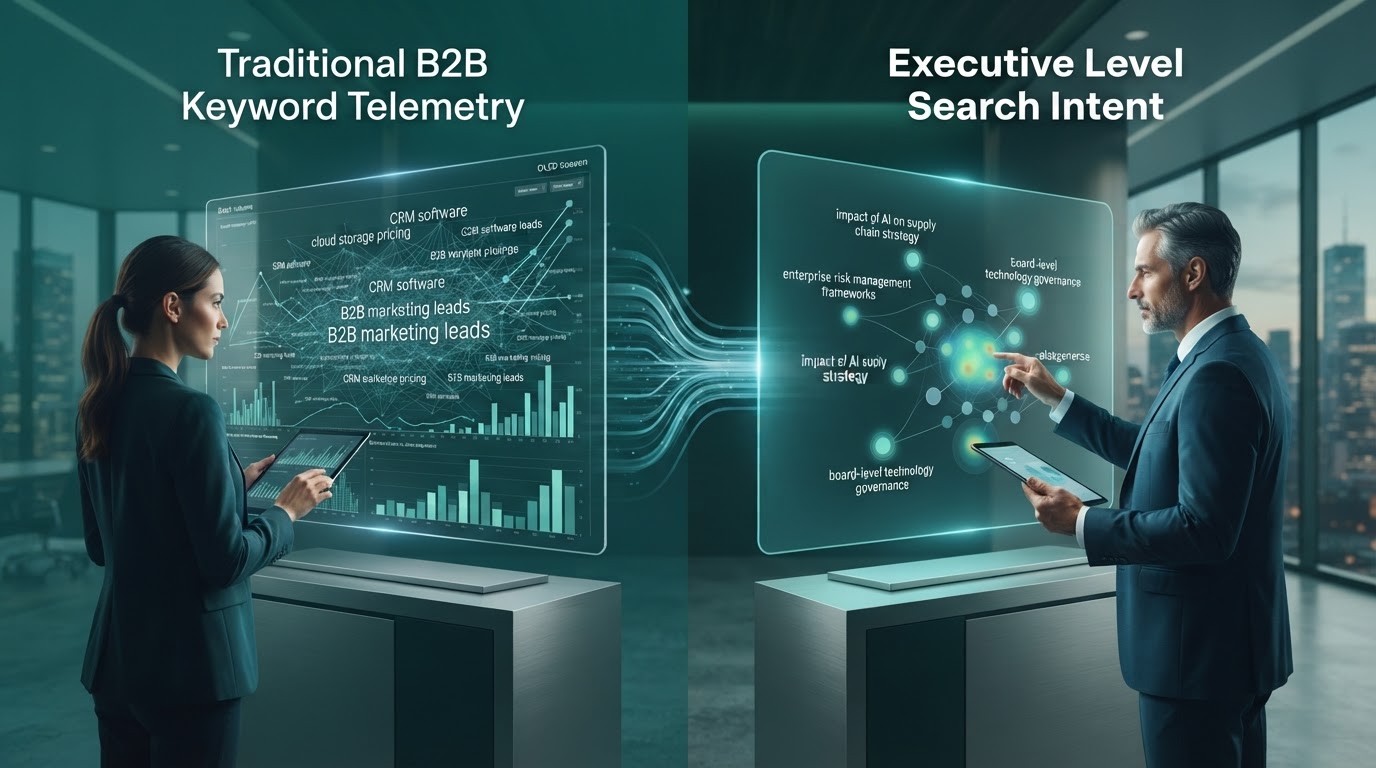
You track executive-level search intent by isolating low-volume, governance-focused query syntax within first-party search telemetry, resolving landing page visits to enterprise accounts via reverse-DNS intelligence, and monitoring citation inclusion within generative engine answers. Traditional search engine optimization focuses on raw click volume, but enterprise leaders do not search like end users or functional managers. C-suite buyers focus on risk mitigation, capital allocation, vendor consolidation, and regulatory compliance, making aggregate keyword metrics irrelevant for identifying high-value pipeline opportunities.
Executing this tracking protocol requires three operational shifts across your analytics infrastructure:
- Deconstruct strategic syntax. Filter organic telemetry for executive lexical markers like consolidation, governance, migration debt, and total cost of ownership.
- Deanonymize target accounts. Connect low-volume URL hits to specific corporate domains using reverse-DNS IP lookup tools integrated with your web analytics stack.
- Audit generative engine citations. Track how large language models cite your domain when answering enterprise procurement, architecture, and vendor evaluation prompts.
Key Takeaways
| Point | Details |
|---|---|
| Search Volume Fallacy | Executive search queries rarely register in public SEO databases because they log fewer than 10 searches per month, yet they represent six-figure and seven-figure contract values. |
| First-Party Data Priority | Third-party tools drop low-frequency queries. Google Search Console regex filters and server log analysis provide the only reliable record of true executive search strings. |
| Multi-Stakeholder Attribution | According to Gartner's B2B buying journey research, typical enterprise buying groups involve 6 to 10 decision-makers, meaning executive intent signals appear during mid-stage and late-stage technical evaluation rather than early problem discovery. |
| AI-Mediated Discovery | Modern executives increasingly query conversational AI models. Capturing executive demand requires tracking retrieval-augmented generation (RAG) citations across generative engines. |
| Automated Asset Deployment | Tracking signals is useless without immediate content deployment. CitedGiraffe scans your site for topical visibility gaps and publishes the precise technical architecture, governance, and comparative content enterprise buyers demand. |
Table of Contents
- Executive Search Intent Differs Radically from Traditional B2B Keyword Telemetry
- Deconstruct the Semantic Taxonomy of Enterprise Leadership Queries
- Isolate Hidden Executive Queries in Google Search Console Using Custom Regex
- Integrate First-Party IP Intelligence to Map Organic Telemetry to Target Accounts
- Track Executive Query Trajectories Across AI Engines and LLM Citations
- Detect SERP Drift and Content Volatility on High-Stakes Commercial Keywords
- Connect Executive Search Intent Signals to Pipeline and Revenue Attribution
- Structure Content Frameworks That Satisfy Executive Evaluation Standards
- Our Stance: Why Traffic Volume Metrics Corrupt Enterprise SEO Strategy
- Automate Executive-Grade Content Production with CitedGiraffe to Close Visibility Gaps
- Next Steps: 90-Day Implementation Timeline
- FAQ
- Sources
- Recommended Reads
Executive Search Intent Differs Radically from Traditional B2B Keyword Telemetry
Traditional search engine optimization relies heavily on raw traffic volume, keyword difficulty scores, and broad match expansion. In consumer software and low-touch SaaS markets, this model works. An individual contributor searches for tactical solutions like "how to format a spreadsheet" or "best time to send an email." These queries register tens of thousands of monthly searches. Marketers capture this demand with simple guides and product checklists.
Enterprise executives do not execute these searches. A Chief Information Security Officer (CISO), Chief Financial Officer (CFO), or Chief Technology Officer (CTO) does not search for basic software definitions or execution playbooks. When an executive approaches a search engine or an AI assistant, they evaluate balance sheet liabilities, strategic vendor consolidation, implementation timelines, and security certifications. Treating executive intent as simple top-of-funnel discovery causes enterprise marketers to produce high-volume educational assets that attract students and junior practitioners while generating zero qualified enterprise pipeline.
What it is not: Tracking executive-level search intent is not standard long-tail SEO research, nor is it finding generic informational keywords with low competition scores. It is the continuous operational isolation of queries that indicate strategic fiduciary decisions, platform migrations, and vendor scrutiny within high-contract-value enterprise accounts.
The Semantic Signatures of C-Suite Decision-Makers
Executive searches feature distinct linguistic structures. While operational managers query features and workflows, senior leaders query trade-offs and structural risk. You can identify these semantic signatures through specific lexical modifiers:
- Risk mitigation modifiers: Enterprise buyers include words like "compliance," "SOC 2 Type II audit requirements," "GDPR data residency liabilities," and "SLA penalty structures."
- Financial architecture modifiers: CFOs and procurement vice presidents evaluate purchases using terms like "capex vs opex allocation," "TCO over 36 months," "seat license consolidation," and "amortization schedule."
- Structural operational modifiers: CTOs evaluate systems using terms like "data migration latency," "multi-tenant security boundaries," "single tenant dedicated tenancy," and "API rate limit parity."
When you spot these modifiers within your search engine logs, you are not observing casual browsing. You are observing a high-stakes evaluation stage in an active enterprise procurement cycle.
The Zero-Volume Trap in Standard Third-Party SEO Tools
The biggest obstacle to tracking executive intent is the "zero-volume" trap. Commercial SEO software aggregates data by sampling clickstream databases, third-party search panels, and historical Google Ads data. Because true enterprise buyers represent an extremely small percentage of the broader population, their hyper-specific queries rarely reach the statistical threshold required to show search volume. As a result, mainstream SEO tools assign them a search volume of 0 to 10 searches per month.
Enterprise marketing teams reliant on volume-based keyword sorting discard these terms immediately. This creates a severe blind spot. A query showing zero search volume in a public database may generate only 4 clicks annually in your Google Search Console telemetry, but those 4 clicks can originate from a Fortune 500 procurement committee reviewing a $750,000 annual software contract. If you design your keyword tracking around monthly search volume thresholds, you systematically eliminate every query your C-suite target audience performs.
Deconstruct the Semantic Taxonomy of Enterprise Leadership Queries
To measure executive search patterns, you must organize their search vocabulary into operational categories. Rather than relying on traditional labels like informational, navigational, or transactional, build a taxonomy that mirrors how an enterprise leadership team structures a vendor review.
| Intent Category | Target C-Suite Role | Example Real-World Queries | Underlying Business Motive |
|---|---|---|---|
| Regulatory & Security Governance | CISO, Chief Legal Officer, VP Security | enterprise data retention policy HIPAA cloud backup, SOC2 compliance shared responsibility model | Eliminate regulatory exposure and avoid contractual liability fines. |
| Consolidation & TCO | CFO, VP Procurement, CIO | vendor consolidation enterprise SaaS stack, platform migration ROI calculator multi-year contract | Cut recurring operational expenditure and eliminate duplicative vendor overhead. |
| Architecture & Migration Feasibility | CTO, VP Engineering, Enterprise Architect | legacy mainframe to hybrid cloud migration rollback plan, database federation latency overhead enterprise | Prevent architectural bottlenecks, technical debt, and unplanned system downtime. |
| Operational Continuity & SLAs | Chief Operating Officer, Head of Infrastructure | financial services uptime SLA four nines credit schedule, enterprise disaster recovery rpo rto benchmark | Ensure revenue-critical operations survive regional infrastructure failures. |
Governance, Risk, and Regulatory Compliance Queries
Regulatory queries surface when an enterprise prepares to put a vendor on its approved procurement list. The searchers here are CISOs, compliance directors, and external legal counsel. They do not read high-level product overviews. They evaluate whether adopting your platform introduces legal or regulatory exposure.
Queries in this category feature rigorous technical terminology: ISO 27001 Annex A controls, FedRAMP High baseline requirements, EU-US Data Privacy Framework cross-border data transfer mechanisms, and HIPAA Business Associate Agreements (BAAs). Tracking traffic to pages addressing these terms reveals when prospective accounts enter formal security reviews.
Vendor Consolidation and Total Cost of Ownership Queries
Economic headwinds force CIOs and CFOs to reduce the total number of SaaS vendors in their operating budget. When executives execute consolidation queries, they look to replace multiple point solutions with a single unified platform. They search for direct financial comparisons, sunset strategies, and migration trade-offs.
Queries such as "total cost of ownership legacy CRM vs unified enterprise platform" or "hidden costs of multi-vendor martech stack" indicate an executive building an internal business case for an upcoming budget cycle. If your tracking systems capture queries evaluating migration payback periods, you can forecast commercial demand long before an enterprise submits a sales inquiry.
Enterprise Architecture and Scalability Inquiries
CTOs and enterprise architects search to eliminate technical failure points before presenting proposals to the board. They evaluate scaling limits, horizontal concurrency, API limits, and dedicated single-tenant topologies.
Queries like "zero downtime database sharding architecture enterprise" or "microservices event sourcing throughput limits" indicate an organization experiencing architectural strain. These buyers evaluate your documentation, technical architecture whitepapers, and engineering benchmarks to confirm your platform can process their production workloads without failure.
Pro tip. Never gate enterprise architecture whitepapers or security compliance overviews behind lead forms. Executives and enterprise architects refuse to submit corporate credentials for basic documentation. Ungate your technical and governance specifications, then use server logs and reverse-DNS tracking to identify the companies consuming those assets.
Isolate Hidden Executive Queries in Google Search Console Using Custom Regex
Third-party keyword software cannot see your private search queries, but Google Search Console (GSC) records every impression and click your domain receives across search results. Because C-suite queries feature distinctive vocabulary, you can build custom regular expressions (regex) within GSC to strip away operational noise and expose executive intent signals.
Navigate to the Performance tab in Google Search Console. Under the Query filter, choose Custom (regex) and select Matches regex. Paste the following enterprise governance expression into the filter:
(?i)\b(compliance|governance|soc\s?2|iso\s?27001|hipaa|gdpr|data\sresidency|audit\strail|fedramp|sla|rto|rpo|vendor\srisk)\b
This expression isolates all impressions and clicks tied to corporate compliance and risk evaluation. To identify enterprise financial and consolidation queries, apply a financial syntax regex filter:
(?i)\b(tco|total\scost|consolidation|procurement|capex|opex|contract\snegotiation|roi\scalculator|license\sconsolidation|enterprise\spricing)\b
To unearth enterprise architecture evaluations, run a technical framework filter:
(?i)\b(enterprise\sarchitecture|tenant\sisolation|multi-tenant|single-tenant|migration\sframework|system\slatency|scalability\sbenchmark|high\savailability|disaster\srecovery)\b
Analyze the resulting output closely. Look specifically for queries that register fewer than 20 impressions over a 90-day window but maintain an average position between 1.0 and 5.0. Cross-reference the landing pages receiving these impressions. If impressions on these queries spike without a corresponding increase in clicks, the title tags and meta descriptions on your enterprise landing pages likely fail to address the executive's governance or economic criteria. For a deeper understanding of intent changes, review our guide on how to track search intent across SERP shifts.
Integrate First-Party IP Intelligence to Map Organic Telemetry to Target Accounts
Google Search Console shows the exact queries searchers use, but it strips all user identities to protect privacy. Web analytics platforms like Google Analytics 4 report on landing pages, but they categorize high-value organic traffic as anonymous aggregate sessions. To connect executive search patterns to commercial pipeline, you must integrate first-party IP intelligence into your analytics infrastructure.
Deploying Reverse-DNS Deanonymization at the URL Level
Every HTTP request delivered to your web server contains the client's public IP address. Enterprise organizations route their corporate networks through dedicated, static IP blocks registered with Regional Internet Registries like ARIN, RIPE, and APNIC. Reverse-DNS lookup tools resolve these IP addresses back to the registered corporate domain name.
By integrating a real-time IP lookup script into your website's header or tag manager, you can pass the resolved account name directly into your web analytics layer as a custom event or user-scoped dimension. When an anonymous visitor reads an un-gated page titled "SOC 2 Type II System and Organization Controls: Shared Responsibility Matrix," your analytics record does not just register an anonymous pageview. It records that an employee on the corporate network of a global investment bank spent 4 minutes reading your compliance documentation.
Enterprise marketers who master this architecture align organic query trends with account-based marketing (ABM) target accounts. If your GSC data reveals fresh impressions for "enterprise migration debt audit" and your IP deanonymization software logs visits to that same URL from an active enterprise prospect, your revenue operations team gains actionable procurement telemetry.
Tracking Buying Committee Touchpoints Across the Organic Funnel
Enterprise purchases are rarely made by an isolated individual. As documented in the Harvard Business Review's study on modern B2B buying behavior, successful technology purchases require alignment across cross-functional committees comprising finance, operations, security, and line-of-business leaders. You can track this buying dynamic across your organic analytics data:
- Phase 1: Operational Discovery. Junior engineers or analysts visit functional documentation and API references. IP intelligence identifies the target enterprise account.
- Phase 2: Architectural Validation. Enterprise architects land on system throughput benchmarks, concurrency limits, and migration frameworks.
- Phase 3: Executive Risk Evaluation. C-suite leaders and procurement specialists visit your enterprise pricing structure, security posture page, and master services agreement (MSA) terms.
When your analytics platform records visits from the same corporate IP across all three distinct content categories over a 30-day window, you have discovered an active enterprise buying cycle. Track user navigation patterns using tools like Google Analytics Path Exploration to identify where executive visits enter and exit these evaluation paths.
Pro tip. Create an automated webhook alerting your enterprise sales team in Slack or Microsoft Teams whenever a verified target account visits a high-intent enterprise URL, such as your compliance audit reports or enterprise SLA specifications. Reaching out with relevant technical resources within 24 hours of an executive visit dramatically accelerates enterprise conversion rates.
Track Executive Query Trajectories Across AI Engines and LLM Citations
Executives increasingly bypass traditional search engine results pages entirely. Instead of scanning blue links, time-pressed leaders prompt generative AI engines like ChatGPT, Claude, and Perplexity to summarize vendor landscapes, extract architectural differences, and calculate operational trade-offs. To track executive intent in modern enterprise environments, you must monitor generative engine optimization (GEO) and citation performance.
Auditing Generative Engine Optimization for Strategic Prompts
Generative artificial intelligence engines rely on retrieval-augmented generation (RAG) pipelines to deliver factual answers to enterprise prompts. When an executive prompts an LLM with a prompt like "Compare the security architecture and compliance guarantees of the top enterprise automation platforms," the underlying system retrieves authoritative external content, extracts key entities, and synthesizes a direct response with source citations.
To measure your brand's executive visibility across these channels, establish a prompt-tracking audit system:
- Define prompt templates: Create a battery of standard evaluation prompts mirroring C-suite priorities across vendor consolidation, regulatory compliance, and total cost of ownership.
- Query large language models systematically: Execute these prompts weekly across leading frontier models and generative search engines, tracking source citations and brand sentiment.
- Analyze source URLs: Identify which competitor domains the LLMs cite as authoritative proof points for enterprise features, architecture designs, and compliance verifications.
If your competitors' pages are cited while your brand is omitted, your content lacks the factual density, semantic clarity, or crawlable information required for RAG ingestion. Learn more about optimizing for these automated engines in our technical breakdown of how generative engines select web citations.
Monitoring Citation Share in Enterprise Comparison Answers
Citation share is the generative search equivalent of traditional organic rank tracking. When an executive prompts an engine for comparative product telemetry, winning a primary citation inside the synthesized answer provides powerful brand validation.
Track your share of citations across a matrix of comparative enterprise prompts. If your domain captures less than 20% of the citations for enterprise-tier queries in your niche, your content infrastructure suffers from a visibility gap. To close this gap, publish dense, factual comparison tables, explicit architectural schematics, and transparent compliance documentation that generative systems can parse effortlessly. Review our guide on how to track AI and human traffic from AI assistants to learn how to measure generative referral traffic in your server logs.
| Metric | Traditional SEO Focus | Executive-Level GEO Focus |
|---|---|---|
| Primary Objective | Maximize clicks and total session volume | Maximize citation inclusion in enterprise buying prompts |
| Tracking Surface | Google Desktop and Mobile SERPs | LLM answer engines and Google AI Overviews |
| Key Measurement | Keyword position (Ranks 1 through 10) | Citation share percentage and sentiment attribution |
| Content Structure | Skimmable, introductory educational guides | Dense, technical specifications and architectural matrices |
Detect SERP Drift and Content Volatility on High-Stakes Commercial Keywords
Search engines adjust their ranking algorithms continuously to improve content relevance. Google documents these systems in detail in their guide to Google Search ranking systems. When Google alters how it interprets a high-stakes search query, this phenomenon is called SERP drift. If an executive query shifts from technical architecture to basic definitions, your conversion pipeline drops instantly.
Track SERP volatility across your target executive keywords to preserve your visibility. Monitor these specific drift signals:
- Intent downgrading: Google replaces technical, whitepaper-style landing pages with lightweight top-of-funnel listicles. This indicates an algorithm shift toward broader consumer intent, requiring you to refine your content's technical vocabulary.
- Format displacement: Google introduces an AI Overview, an interactive calculator, or a video pack above the top organic result. You must restructure your target page using clear semantic HTML headers and schema markup to reclaim top-tier positioning.
- Competitor repositioning: A competing enterprise vendor replaces an introductory product page with an in-depth security architecture breakdown or a detailed total cost of ownership calculator.
Google's quality evaluators prioritize deep expertise, experience, authoritativeness, and trust (E-E-A-T), particularly for high-stakes business decisions. Google details these standards directly in its public Search Quality Evaluator Guidelines, underscoring that content addressing financial and structural decisions must exhibit rigorous technical authority. For tactical workflows on recovering from intent shifts, see our guide on detecting and fixing SERP drift.
Connect Executive Search Intent Signals to Pipeline and Revenue Attribution
Tracking executive search intent produces zero business value if the metrics remain isolated within an SEO dashboard. Enterprise marketing leaders must tie low-volume organic search queries directly to CRM opportunities, sales pipeline velocity, and closed-won enterprise revenue.
"By the time B2B buyers reach out to vendors, they have already framed their own requirements, compared alternative paths, and made critical strategic trade-offs using digital information channels."
— Gartner, B2B Buying Journey Research Report
Mapping Low-Volume Organic Hits to CRM Opportunity Stages
Do not judge the performance of executive content using standard web conversion metrics like contact form fills. C-suite executives rarely complete standard web forms. Instead, map the consumption of executive URLs directly to your customer relationship management (CRM) deal stages.
When an existing pipeline opportunity moves from Initial Discovery to Technical Review, run automated IP lookups to check whether the prospect's corporate domain has visited your security documentation, API limits, or migration frameworks. If an account stalls in Procurement Review, check whether their corporate IP is reading your vendor consolidation pages or SLA penalty terms.
This attribution model transforms SEO reporting. Instead of telling your leadership team that an article earned 12 clicks this quarter, you can prove that those 12 clicks directly supported three enterprise opportunities valued at $450,000 in aggregate pipeline.
Establishing Closed-Loop Feedback Loops with Enterprise Sales Teams
Your enterprise sales team hears executive search intent voiced directly during customer discovery calls. When a Chief Information Officer asks a sales rep a question about SOC 2 compliance during a call, that same CIO or their technical staff searched for that exact problem 48 hours prior.
Establish a monthly feedback loop between enterprise SEO and your sales engineering teams. Solicit their input on three operational questions:
- What specific architectural objections did prospective buyers raise during late-stage calls this month?
- What compliance or regulatory documentation did security teams request during vendor onboarding reviews?
- What alternative solutions or legacy systems were mentioned during vendor consolidation discussions?
Translate the sales team's qualitative insights into precise search queries. Check whether your website ranks for these queries, and immediately build pages for any uncovered topical blind spots.
Structure Content Frameworks That Satisfy Executive Evaluation Standards
Capturing executive intent requires content built to corporate governance standards. If an executive visits your site and finds generic fluff, they bounce immediately. Align your pages with Google's framework for creating helpful, reliable, people-first content by following these structural principles:
- Lead with upfront conclusions: State the executive answer, financial payback period, or security architecture in the opening paragraph. Do not force leaders to scroll past introductory definitions.
- Provide verifiable technical data: Replace vague phrases like "our system is fast and scalable" with concrete performance benchmarks: "our distributed architecture maintains p99 query latency under 45 milliseconds at 15,000 concurrent requests per second."
- Include machine-readable comparison tables: Structure operational trade-offs, pricing models, and security boundary matrices using clean semantic HTML tables. This formats data perfectly for both human executive readers and generative AI RAG parsers.
- Publish transparent compliance documentation: Include explicit data flow diagrams, sub-processor disclosures, and encryption specifications directly on your technical landing pages.
Pro tip. When publishing comparison tables, always highlight concrete trade-offs where your platform may not be the ideal fit. Transparently documenting architectural trade-offs builds immense credibility with enterprise architects, who view uniform 10/10 vendor comparison scores as marketing fiction.
Our Stance: Why Traffic Volume Metrics Corrupt Enterprise SEO Strategy
Most enterprise marketing strategies fail because they optimize for vanity metrics. Marketing leaders report on aggregate organic traffic growth to demonstrate progress to the board. However, chasing raw session volume creates perverse incentives. Teams publish superficial, consumer-oriented content designed to capture high-volume search queries that generate zero enterprise pipeline.
High-volume organic traffic is an operational liability if it does not attract enterprise buying committees. It inflates your infrastructure bandwidth costs, muddles your analytics data with unqualified sessions, and diverts marketing resources away from addressing real executive objections. Enterprise SEO should be measured by target account penetration, pipeline influence, and closed-won contract value. We believe capturing 10 qualified C-suite visits from Global 2000 accounts is infinitely more valuable than acquiring 50,000 top-of-funnel clicks from unqualified consumers. If your SEO strategy prioritizes traffic volume over commercial authority, you are burning capital to build an audience that will never buy your product.
— CitedGiraffe
Automate Executive-Grade Content Production with CitedGiraffe to Close Visibility Gaps
Tracking executive-level search intent reveals specialized topical gaps across your digital content portfolio. When you uncover that enterprise buyers are querying your security compliance, vendor consolidation trade-offs, and platform architecture, you face an immediate operational hurdle: production velocity. Enterprise buyers require dense, technically accurate, authoritative content, but manually producing this material strains internal subject-matter experts and delays publishing schedules by months.
CitedGiraffe solves this enterprise visibility challenge. CitedGiraffe scans your entire domain to isolate the strategic gaps where your content fails to satisfy executive search queries and AI RAG citations. Once those visibility gaps are discovered, CitedGiraffe plans, writes, and publishes search-optimized, enterprise-grade content across your digital properties on complete autopilot.
By automating the production of technical architecture pages, compliance overviews, and commercial comparison assets, your enterprise marketing team maintains consistent visibility across traditional search engines and AI assistants. Let your executive leadership maintain brand strategy while our platform handles the continuous content production required to dominate modern search. Scan your site for free with CitedGiraffe and capture high-value C-suite demand today.
Next Steps: 90-Day Implementation Timeline
| Timeframe | Focus Area | Key Deliverables |
|---|---|---|
| Days 1 to 30 | Telemetry Auditing & Filtering |
|
| Days 31 to 60 | Account Deanonymization & Tracking |
|
| Days 61 to 90 | Content Deployment & CRM Integration |
|
FAQ
How do I find keywords executives use if SEO tools show zero search volume?
Third-party tools drop low-frequency searches due to panel sampling limits. Rely on first-party Google Search Console telemetry instead. Apply custom regular expression filters targeting governance, vendor consolidation, compliance, and enterprise architecture vocabulary over a 90-day to 180-day window to uncover queries generating impressions.
Additionally, interview your enterprise sales engineering team. Customer discovery calls reveal the exact phrasing, regulatory requirements, and technical trade-offs senior decision-makers evaluate during active purchase cycles.
How do C-suite search patterns differ from functional managers?
Functional managers and individual contributors search for tactical workflows, software execution steps, and basic tooling overviews. Their queries focus on everyday operational speed and personal productivity.
In contrast, C-suite executives search for balance sheet risk, regulatory liability, vendor consolidation, implementation timelines, and security controls. They prioritize governance, financial payback, and multi-year total cost of ownership over individual feature capabilities.
Can reverse-DNS tracking reveal remote executives working from home?
Reverse-DNS intelligence relies on static corporate IP address allocations. When an executive works from an unmanaged residential internet connection, standard IP tracking resolves to consumer internet service providers like Comcast or Charter rather than the employer.
However, enterprise executives frequently route their internet traffic through corporate VPNs, secure enterprise access service edge (SASE) platforms, or dedicated corporate gateways. Furthermore, other members of the cross-functional buying committee operating on corporate networks validate account interest even if the remote executive browses off-network.
How often should we audit LLM citations for enterprise brand visibility?
Frontier model weights and real-time retrieval-augmented generation search indices update frequently. Conduct automated audits of your generative citation share across your core battery of executive evaluation prompts every 7 to 14 days.
Regular auditing alerts you whenever an AI platform alters its preferred citation sources, allowing you to update technical comparison tables and compliance content before visibility losses impact inbound pipeline.
Sources
- Gartner: The B2B Buying Journey
- Harvard Business Review: The New Rules of B2B Marketing
- Google Search Central: Creating Helpful, Reliable, People-First Content
- Google: Search Quality Evaluator Guidelines
- Google Search Central: A Guide to Google Search Ranking Systems
- Google Analytics Help: Analyze User Navigation with Path Exploration
Recommended Reads
- How to Track Search Intent: An Operational Playbook for Detecting and Fixing SERP Drift
- How to Track AI and Human Traffic from AI Assistants Like ChatGPT: A Guide for Digital Marketers
- Notes on AI Search Visibility: How Generative Engines and RAG Pipelines Select Web Citations
- Streamline Your Strategy: The Power of AI SEO Automation Workflows