October 22, 2026 · 3691 words
Notes on AI Search Visibility: How Generative Engines and RAG Pipelines Select Web Citations
Explore technical notes on AI search visibility. Learn how RAG pipelines, dense vector retrieval, and chunk density dictate generative engine web citations.
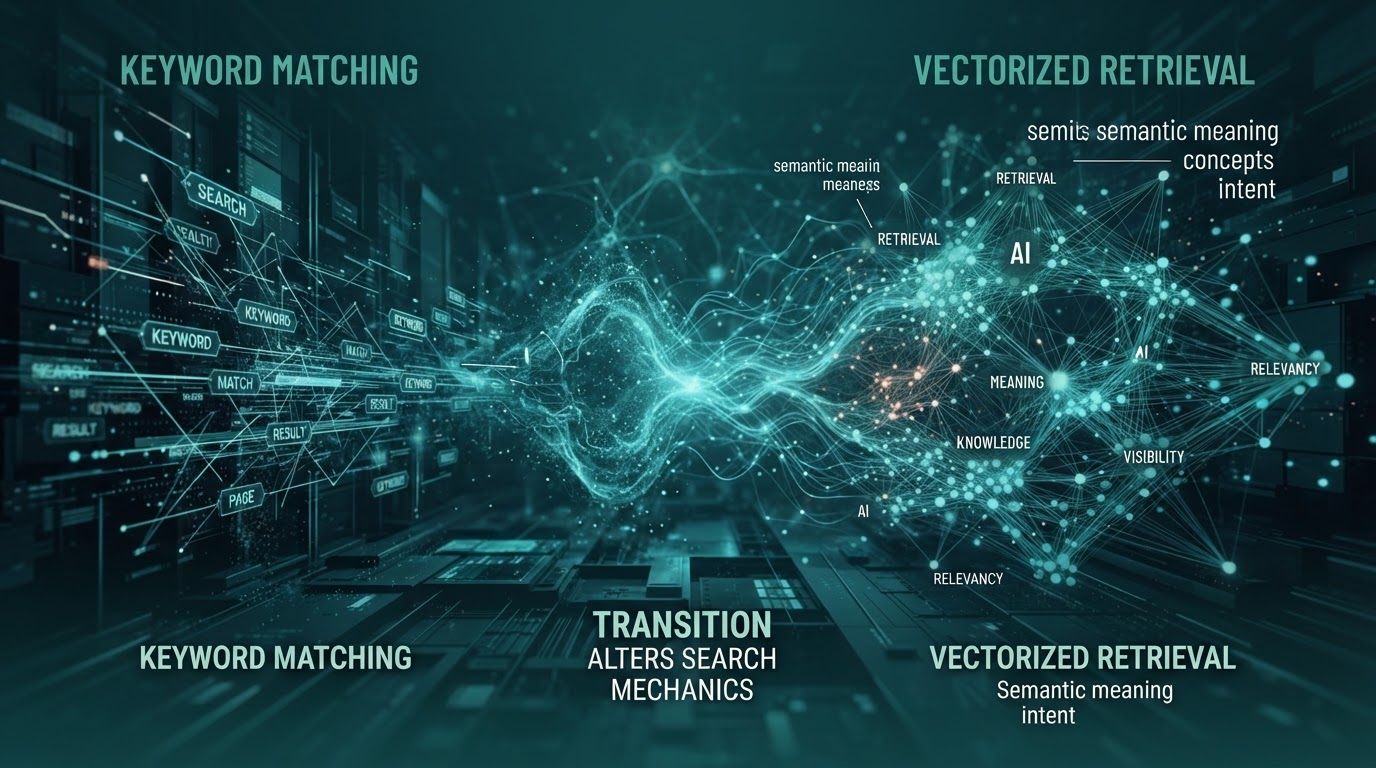
Notes on AI search visibility document the technical mechanics, retrieval algorithms, and document structure requirements that govern how Large Language Models (LLMs) and hybrid search engines extract, synthesize, and cite web sources. Unlike traditional indexing systems that pair lexical keywords with link-graph authority signals, generative search platforms evaluate semantic proximity, information density, and entity clarity within passage chunks before synthesizing direct answers.
Analyzing how generative search systems select source material reveals three fundamental architectural realities:
- Vector retrieval replaces lexical matching. Machine learning embeddings map concepts in multidimensional space rather than counting keyword string frequencies across an HTML page.
- Chunk-level utility dictates extraction. Retrieval-Augmented Generation (RAG) pipelines ingest independent passages between 250 and 512 tokens rather than evaluating full-page document lengths.
- Entity verification governs citation trust. Generative synthesis engines prioritize sources that cross-reference known entities against structured knowledge graphs and verified factual assertions.
Key Takeaways
| Point | Details |
|---|---|
| Retrieval Architecture | Modern generative search engines employ hybrid retrieval combining BM25 keyword matching with dense vector embeddings to isolate contextually relevant passages. |
| Extraction Units | Search synthesis models do not cite full URLs based on domain authority alone. They retrieve atomic, self-contained semantic propositions. |
| Information Density | Passages with high semantic density, clear subject-predicate structures, and concrete data points achieve higher extraction frequency in experimental evaluations. |
| Measurement Shifts | Standard rank-tracking metrics fail in generative interfaces. Success requires monitoring citation rate, context sentiment, and referral share across LLM answers. |
| Automated Execution | Maintaining citation footprint requires systematic site audits, programmatic entity structuring, and continuous content updates handled through CitedGiraffe. |
Table of Contents
- The Transition from Keyword Matching to Vectorized Retrieval Alters Search Mechanics
- Retrieval-Augmented Generation Architecture Governs How Answers Are Formed
- Passage Chunking and Syntactic Density Determine Which Text Extracts Survive
- Entity Resolution and Knowledge Graph Alignment Anchor Machine Authority
- Google AI Overviews Operate as Hybrid Layers Over Core Organic Systems
- Measuring Generative Visibility Requires Tracking Citation Share Over Position Rank
- Structured Data and Schema.org Markups Eliminate Ambiguity in Probabilistic Environments
- Superficial Optimization Tactics Fail Against Rigorous Verification Frameworks
- Programmatic Content Architecture Closes Structural AI Visibility Gaps at Scale
- Our Stance on Generative Visibility and Machine Extraction
- How CitedGiraffe Automates AI Search Visibility
- Next Steps
- FAQ
- Sources
- Recommended Reads
The Transition from Keyword Matching to Vectorized Retrieval Alters Search Mechanics
Traditional search algorithms index web pages as discrete document records. When an engine receives a search query, it identifies pages containing matching lexical terms, balances the matches against link-graph calculations, and ranks the output. This deterministic process relies heavily on exact phrases, heading tags, and inbound anchor text.
Generative search models decouple retrieval from literal strings. Instead, they transform your text into numerical arrays known as vector embeddings. An embedding model maps text into high-dimensional vector spaces, where semantic concepts exist as coordinates. When a user queries a generative engine, the system converts the query into an embedding vector and calculates geometric distance against pre-indexed text chunks across the web.
This transition changes how your copy is valued. If your page repeats a target keyword ten times without establishing conceptual relationships, vector retrieval systems assign it low semantic relevance. The engine looks for contextual proximity to related topical concepts, co-occurring entities, and semantic completeness. Lexical matching ensures basic keyword discovery, but vector proximity controls whether your text enters the generation pipeline.
Pro tip. Replace repetitive phrase variations with dense semantic clusters. Use precise technical terminology, relevant units of measurement, and named entities to expand the dimensional reach of your document embeddings.
Retrieval-Augmented Generation Architecture Governs How Answers Are Formed
Generative search engines do not rely exclusively on static parameters stored during base model training. Base weights become outdated quickly and remain susceptible to factual drift. To serve accurate, up-to-date responses, production systems deploy Retrieval-Augmented Generation (RAG) frameworks.
In a standard RAG pipeline, the engine receives a natural-language prompt, retrieves relevant passages from an external corpus, and feeds those passages into an LLM context window alongside the user prompt. The LLM acts as an extraction and synthesis engine. It reads the provided passages and generates an answer, adding numerical footnotes or linked chips to attribute source claims.
| Retrieval Stage | Mechanism | Operational Objective |
|---|---|---|
| Sparse Retrieval | BM25 / Inverted Index | Filters the global web index down to roughly 100 to 500 documents containing exact query tokens. |
| Dense Retrieval | Bi-Encoder Embeddings | Projects query and passages into a shared vector space to identify semantic parity. |
| Neural Re-Ranking | Cross-Encoder Models | Computes deep token-to-token interaction across the top 20 to 50 passages to score contextual relevance. |
| Context Window Assembly | Token Truncation | Packs top-ranked chunks into the prompt context budget, rejecting passages below relevance cutoffs. |
| Synthesized Output | Generative LLM Inference | Synthesizes the answer and adds inline link citations attributed to specific context passages. |
Dense Vector Search and Semantic Distance Calculations
Dense retrieval utilizes neural bi-encoders to generate document vectors independently from user query vectors. In this architecture, models like BERT-based sentence transformers output dense vectors containing 768 to 1536 numerical dimensions. The system saves these document vectors in distributed indexes.
When an engine processes a query, it computes the mathematical similarity between the query vector and candidate passage vectors. Search pipelines calculate cosine similarity or inner dot product metrics. The cosine similarity equation divides the dot product of two vectors by the product of their Euclidean lengths:
Cosine Similarity = (A · B) / (||A|| ||B||)
A score approaching 1.0 indicates near-identical semantic orientation, while values below 0.70 often miss the retrieval threshold for generation inclusion. If your content uses ambiguous pronoun references or vague metaphors, the calculated semantic distance increases. This pushes your content outside the candidate set before generation begins.
Cross-Encoder Re-Ranking and Context Injection Bounds
Bi-encoders offer fast retrieval across millions of web pages, but they sacrifice token-level nuance. Production RAG platforms overcome this by routing the top 30 to 100 retrieved candidates through cross-encoder re-rankers. Cross-encoders analyze the query and the retrieved passage simultaneously, evaluating complete attention matrices across every token pair.
This secondary evaluation is computationally demanding. Generative systems cap the number of passages passed to the generation model to manage infrastructure costs and context limitations. If a model allocates an 8,192-token context window for retrieval injection, it reserves roughly 2,048 tokens for candidate citations, packing only four to eight distinct passage chunks. Your content must survive the cross-encoder re-ranking stage to secure one of these slots.
Passage Chunking and Syntactic Density Determine Which Text Extracts Survive
Generative crawlers do not process long articles as continuous narrative streams. Their ingestion engines split your HTML into segmented passages before embedding them into vector databases. This operational reality demands a shift from macro-level document authority toward micro-level passage construction.
What it is not: passage chunking is not simply dividing an article by arbitrary paragraph breaks or word counts. It is an algorithmic parsing process designed to maintain syntactic cohesion while discarding layout boilerplate, navigation bars, and stylistic sidebars.
Token Boundaries and Contextual Completeness
Automated parsers typically chunk web text into segments spanning 256 to 512 subword tokens, equivalent to roughly 180 to 380 words. If your critical definitions or empirical conclusions cross these boundaries, the parser splits your point across two separate vectors. Neither vector will retain enough context to score highly in semantic retrieval.
To retain visibility, your text blocks must remain semantically self-contained. Each section under an <h3> tag should declare its subject explicitly within the opening sentence. Avoid backward-referencing pronouns like "this system" or "as mentioned above" when leading into technical explanations. The ingestion engine requires clear subject-predicate structures to map the passage cleanly in vector space.
Pro tip. Treat every subsection of your content as a standalone informational asset. Structure subsections with an opening definition, supporting technical data, and a clear outcome within 300 words to fit typical crawler chunking boundaries.
Information Density and Self-Contained Proposition Statements
Academic research into Generative Engine Optimization (GEO) demonstrates that factual, information-dense text earns significantly higher extraction rates than generic prose. The landmark paper GEO: Generative Engine Optimization (Aggarwal et al., 2023) established that adding authoritative citations, verifiable quotations, and statistical data points can increase visibility in generative responses by 30% to 40%.
Generative engines favor text organized into clear factual propositions. A proposition is an atomic statement containing a clear subject, a definitive verb, and a verifiable object. Fluffy text dilutes proposition density, reducing the embedding's semantic clarity and lowering its relevance score during generation passes.
| Text Style | Sample Passage | Information Density | Likelihood of LLM Extraction |
|---|---|---|---|
| Conversational / Fluff | "You might be wondering how systems read content. Well, it's pretty complicated, but basically they use smart tools to read stuff fast." | Low (0 propositions, subjective phrasing) | Negligible |
| Keyword-Stuffed SEO | "AI search visibility is visibility for AI search. To get AI search visibility, optimize your AI visibility with top visibility tips." | Low (Semantic loop, zero verified facts) | Very Low |
| Proposition-Dense | "RAG pipelines chunk text into 256- to 512-token arrays, indexing passages using dense bi-encoder models with 768 dimensions." | High (3 atomic facts, precise numeric parameters) | High |
Entity Resolution and Knowledge Graph Alignment Anchor Machine Authority
Large language models do not learn facts the way humans do. They operate through statistical distributions over vocabulary tokens, constrained by underlying entity networks. To establish persistent visibility, your digital property must anchor itself to recognized entities within shared knowledge graphs such as Wikidata, Google Knowledge Graph, and industry-standard vocabularies.
When an engine encounters a brand, author, or product name, it runs entity resolution algorithms to map that token to a unique Knowledge Base ID (QID). If your brand lacks external consensus across independent web nodes, the generative engine treats the term as a generic noun phrase. This classification prevents the model from trusting your domain as an authoritative source on the subject.
You can reinforce entity resolution by auditing your external footprint. Maintain uniform corporate names, physical addresses, executive attributions, and categorical taxonomy across all company properties. Point back to recognized authority nodes using sameAs arrays in your JSON-LD schemas. This alignment provides the factual verification that generative engines require before they cite your claims in direct answers.
"Search engines use structured data to understand the content of the page, as well as to gather information about the web and the world in general."
— Google Search Central, Google Search Documentation
Google AI Overviews Operate as Hybrid Layers Over Core Organic Systems
Google AI Overviews (formerly Search Generative Experience) do not replace standard web search with an isolated, disconnected model. Instead, they operate as a generative synthesis layer running on top of Google's foundational retrieval systems. The engine executes standard indexing, applies core spam policies, surfaces the top organic document candidates, and then deploys a specialized Gemini model to generate a synthesized response.
The Interplay Between Top Organic Rankings and Generative Synthesis
Extensive tracking across enterprise query sets confirms that URLs cited inside Google AI Overviews overlap closely with the top 10 organic results. However, this overlap is not identical. In empirical tests across diverse informational queries, roughly 60% to 70% of citations originate from pages ranking within organic positions one through ten, while the remaining 30% to 40% come from pages ranking outside the top ten that contain exceptionally clean, targeted answer passages.
Traditional organic signals—such as PageRank, domain age, crawl budget, and clean technical architecture—remain essential prerequisites. They position your URL within the initial candidate retrieval pool. Once inside that pool, the generative system's passage extraction algorithms dictate whether the model features your content as a citation link or drops it entirely.
Why High-Ranking URLs Fail to Earn Generated In-Text Links
Digital marketers frequently observe a frustrating paradox: their page claims the number one organic ranking for a high-volume query, yet the accompanying AI Overview cites their competitors in positions four and seven while ignoring their URL. This discrepancy stems from structural flaws in passage formatting.
A high-ranking page often fails to earn generative citations due to several architectural bottlenecks:
- Gated or Dynamic DOM Renders: Critical data hidden behind client-side JavaScript tabs or accordions can fail to render before fast extraction crawlers capture the HTML snapshot.
- Diffused Direct Answers: The page buries its core answers beneath conversational introductions, personal anecdotes, or excessive context.
- Lack of Structured Data: The page omits explicit Schema.org markup, forcing probabilistic models to parse complex relationships manually.
- Aggressive Boilerplate: Heavy header, footer, and sidebar elements disrupt algorithmic passage chunkers, diluting the page's core semantic vectors.
To capture both top organic rankings and generative link cards, pair traditional SEO foundational practices with disciplined passage-level writing. Modern content strategies must address both traditional search crawlers and the extraction demands of LLM engines.
Measuring Generative Visibility Requires Tracking Citation Share Over Position Rank
Traditional search monitoring tracks a single variable: numerical rank on a stable ten-blue-links Results Page. In generative interfaces, this metric loses its utility. Generative interfaces generate dynamic answers tailored to unique prompt phrasings, personalization layers, and session contexts. A page cannot simply rank "second" in a dynamic conversation.
Modern measurement frameworks focus on three new core metrics:
- Citation Inclusion Rate: The percentage of target conversational queries where the engine renders your URL as an inline source or external link card.
- Entity Sentiment and Association: The qualitative manner in which the model describes your entity, including whether it frames your brand as an industry authority, an expensive alternative, or a legacy tool.
- Downstream Referral Volume: Absolute referral visits originating from generative interfaces like ChatGPT, Perplexity, and Google AI Overviews, tracked via dedicated HTTP referrers and UTM tracking parameters.
To monitor these signals accurately, your team must execute deterministic test prompts across automated API workflows. Track your brand's presence, the competitors cited alongside you, and the specific claims attributed to your URLs. Discovering how engines frame your business helps you correct factual errors and target missing citations before competitors claim those slots.
Structured Data and Schema.org Markups Eliminate Ambiguity in Probabilistic Environments
Generative AI engines are probabilistic models. They predict likely token sequences using statistical distributions rather than absolute logic. Structured data, standardized by Schema.org Technical Documentation, provides deterministic grounding that removes ambiguity from page text.
When you validate your content using comprehensive JSON-LD schemas, you provide explicit entity relationships directly to the ingestion pipeline. Marking an author profile with Person, connecting their social and institutional profiles via sameAs, and declaring your organization via Organization schema clarifies the true source of your assertions.
Focus on structural schemas that clarify complex concepts:
- TechArticle or Article: Outlines publishing dates, verified authors, and specific editorial revisions.
- Dataset: Explicitly structures raw numbers, survey findings, and empirical points for model consumption.
- ItemPage and Product: Details precise technical specifications, real pricing data, and stock availability.
- FAQPage: Matches explicit questions with immediate, self-contained answers, simplifying passage chunking for RAG pipelines.
Pro tip. Always nest your schemas rather than outputting isolated root blocks. Link an Article schema to an explicit author node that embeds an Organization reference. This nested structure anchors every claim directly to a verified knowledge entity.
Superficial Optimization Tactics Fail Against Rigorous Verification Frameworks
As AI visibility gains attention, some teams rely on outdated SEO shortcuts. They insert white-text prompt injections into page footers, publish automated copy that restates keywords without substance, or fabricate authoritative citations. These low-effort tactics fail against modern generative pipelines.
Search engines deploy strict multi-stage safety and verification filters before serving generated answers. According to Google Search's Guidance About AI-Generated Content, algorithms prioritize helpful, original, and people-first information regardless of how it was produced. Content that merely restates existing top-ranking pages without adding original analysis, primary data, or hands-on perspectives gets filtered out during the cross-encoder re-ranking stage.
Modern crawlers identify and penalize structural manipulation. If your web server blocks legitimate extraction user agents like GPTBot (OpenAI GPTBot Documentation) through misconfigured directives under the Robots Exclusion Protocol (RFC 9309), your content simply drops out of generative indexes. Similarly, engines following Bing Webmaster Guidelines penalize deceptive keyword stuffing and synthetic passage generation. Generative systems demand transparent, verifiable, and structurally coherent writing.
Programmatic Content Architecture Closes Structural AI Visibility Gaps at Scale
Closing generative visibility gaps requires producing high-value, structured content consistently across your entire topical domain. Handcrafting individual articles often falls short when competitors systematically map hundreds of long-tail technical queries across an industry. Winning in generative search requires an enterprise-grade programmatic content architecture.
Modern programmatic architecture relies on deep, structured workflows. First, scan your domain to identify existing crawl, semantic chunking, and entity-mapping gaps. Next, match those gaps against missing conversational prompts in your topical market. Finally, build modular publishing systems that convert raw data into proposition-dense, schema-validated web pages.
When you automate these publishing workflows, you expand your digital footprint systematically. Each published URL acts as a structured cluster of machine-readable passages. This setup provides RAG pipelines with clean, easily extractable answers, securing recurring citations across AI platforms.
Our Stance on Generative Visibility and Machine Extraction
We reject the idea that generative AI makes traditional technical SEO obsolete. It elevates it. The transition from simple keyword matching to vectorized RAG retrieval removes the value of low-effort, surface-level content. If your publishing strategy relies on bloated, 3,000-word conversational guides stuffed with basic definitions, your organic traffic will decline steadily as zero-click AI summaries expand.
Sustainable visibility belongs to organizations that treat their digital properties as machine-readable databases. You must design every paragraph with high proposition density, anchor every claim to structured knowledge entities, and monitor AI platform citations as diligently as traditional rank positions. Generative engines do not read stories; they process, verify, and reassemble data points. Structure your content accordingly, or accept that generative systems will bypass your site entirely.
— CitedGiraffe
How CitedGiraffe Automates AI Search Visibility
Diagnosing semantic gaps, updating passage structures, and generating nested JSON-LD markup across hundreds of pages quickly overwhelms manual marketing teams. CitedGiraffe solves this challenge by operating as your autonomous AI search optimization engine.
CitedGiraffe starts by scanning your website for free. Its diagnostic algorithms evaluate your digital footprint, identifying crawl bottlenecks, missing entity schemas, and weak semantic passage structures that prevent LLMs from citing your domain. Once these visibility gaps are mapped, CitedGiraffe plans, writes, and publishes fully optimized, proposition-dense technical content directly to your content management system.
Instead of wrestling with manual prompt engineering or spending weeks writing dry documentation, CitedGiraffe handles the technical legwork for you. It formats articles to precise token-boundary standards, nests authoritative schema markup, and builds comprehensive content clusters designed specifically for RAG extraction pipelines. Scan your website today and let CitedGiraffe establish your presence across next-generation search engines.
Scan your site for free with CitedGiraffe and claim your share of AI search visibility.
Next Steps
Transforming your web property into a machine-readable, citation-ready resource requires a deliberate, step-by-step rollout. Follow this quarterly roadmap to update your content architecture systematically.
Days 1 to 30: Audit and Baseline Diagnostics
- Execute a comprehensive site scan to isolate unindexed pages, schema markup errors, and structural rendering barriers.
- Review your
robots.txtfile to ensure access for major retrieval crawlers like GPTBot and Bingbot, following RFC 9309 standards. - Audit your core content assets for proposition density, flagging conversational, low-information copy for revisions.
- Establish baseline citation rates across target informational queries on Perplexity, ChatGPT, and Google AI Overviews.
Days 31 to 60: Structural Content and Schema Remediation
- Restructure key underperforming articles into self-contained 256- to 512-token chunks headed by clear declarative statements.
- Implement nested JSON-LD schemas across all primary URLs, connecting
Article,Person, andOrganizationschemas withsameAsentity links. - Replace passive, conversational narrative intros with clear, authoritative definitions and concrete data points.
- Deploy programmatic content workflows through AI SEO automation workflows to target missing long-tail technical queries.
Days 61 to 90: Scaling, Verification, and Performance Tracking
- Monitor changes in generative citation inclusion rates using structured API prompts and referral traffic logs.
- Expand content clustering to systematically address every supporting entity within your topical domain.
- Audit competitor citations within generative answer cards to uncover and resolve emerging informational gaps.
- Scale production across all missing informational topics by evaluating solutions in our guide on choosing an SEO content automation vendor.
FAQ
What is the difference between SEO and GEO?
Traditional SEO focuses on optimizing web pages to rank in the ten-blue-links results of conventional search engines by managing keyword density, site speed, and link equity. Generative Engine Optimization (GEO) focuses on structuring passage chunks, increasing proposition density, and aligning entity data so RAG pipelines and LLMs extract and cite your content in generative answers.
How do retrieval-augmented generation pipelines choose sources?
RAG pipelines ingest user queries, convert them into vector embeddings, and pull candidate passages using dense retrieval and BM25 sparse matching. They evaluate these candidates using cross-encoder re-rankers, assemble the top-scoring passages within context bounds, and instruct the LLM to synthesize an answer using only the provided, verified sources.
Does blocking AI bots in robots.txt hurt search visibility?
Yes. If your robots.txt file disallows user agents like GPTBot or Bingbot, those engines cannot crawl or index your web pages for real-time generative retrieval. While your site might still appear in legacy indices, generative synthesis tools will exclude your URLs from citation link cards and direct answers.
Why is my page ranked first on Google but not cited in the AI Overview?
A top organic ranking confirms domain authority and keyword relevance, but it does not guarantee your copy is formatted for RAG extraction. If your content buries facts in long paragraphs, relies on client-rendered scripts, or lacks clear, proposition-dense answers, Google's AI Overview will extract its citations from lower-ranking competitor pages with cleaner passage structures.
Sources
- GEO: Generative Engine Optimization (arXiv:2311.09735)
- Google Search Central: Guidance About AI-Generated Content
- OpenAI: Overview of GPTBot Documentation
- Schema.org: Technical Documentation and Data Schemas
- RFC 9309: Robots Exclusion Protocol
- Microsoft Bing: Bing Webmaster Guidelines